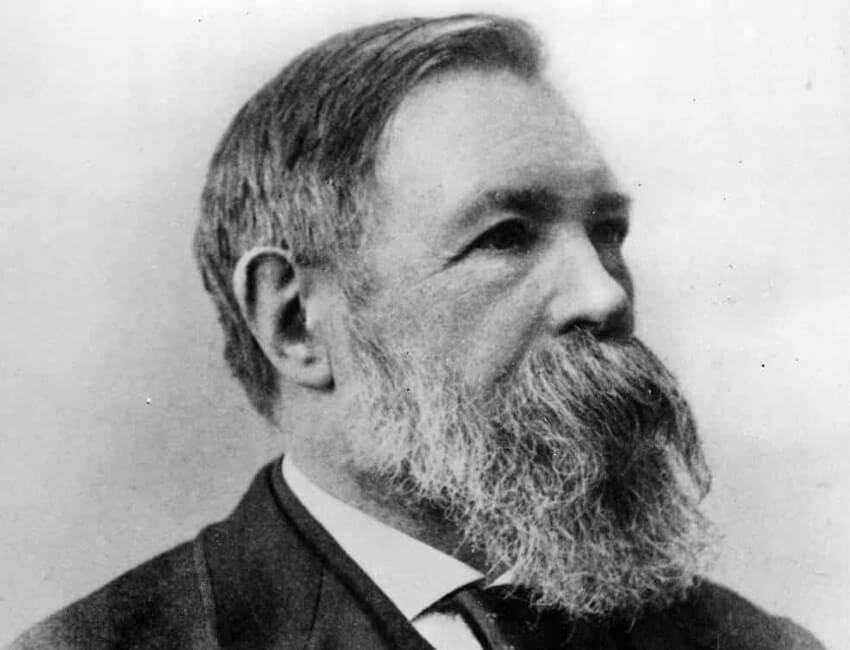
Frederick Engels, often overshadowed by his collaborator Karl Marx, played a crucial role in the development of Marxist philosophy and theory.
Engels’ contributions were not merely limited to being Marx’s sidekick; his own works and philosophical insights demonstrate his independent intellectual prowess.
This blog post aims to explore the philosophical contributions of Frederick Engels and evaluate whether his ideas can stand on their own, separate from Marx’s influence.
Marx & Engels: The Dynamic Duo
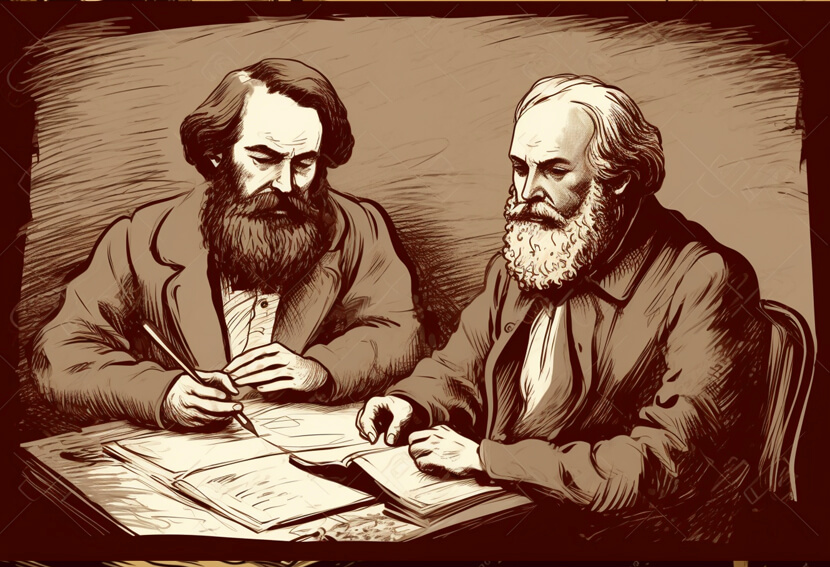
Frederick Engels and Karl Marx forged a deep friendship and intellectual partnership that lasted throughout their lives. Engels provided significant financial and emotional support to Marx, enabling him to dedicate himself fully to writing and research.
Their collaboration led to seminal works such as “The Communist Manifesto” and “Capital.” While Marx’s ideas took centre stage, it is important to recognise Engels’ critical role in shaping and expanding the foundations of Marxist theory.
Who Was Frederick Engels?
Frederick Engels, born on November 28, 1820, in Barmen, Germany, was a prominent philosopher, social scientist, and revolutionary thinker. Engels’ life and intellectual contributions were closely intertwined with his collaboration with Karl Marx. Engels came from a wealthy industrialist family, which provided him with a comfortable upbringing and access to education. However, his experiences working in his father’s textile factory exposed him to the harsh realities of industrial capitalism and fueled his commitment to the cause of the working class.
Engels was not only a prolific writer and thinker but also an active participant in revolutionary activities. He played a significant role in various workers’ and socialist movements, particularly in Germany, France, and England. Engels also helped establish the First International, a global organisation dedicated to advancing workers’ rights and socialist ideals. His commitment to activism and his efforts to bridge theory and practice further solidify his legacy as a key figure in the socialist and revolutionary movements of the 19th century. Engels passed away on August 5, 1895, in London, leaving behind a rich body of work that continues to inspire and shape political thought to this day.
Independence in Thought and Writing
Engels’ independent contributions to Marxist theory became apparent in his solo works, such as “The Condition of the Working Class in England” and “The Origin of the Family, Private Property and the State.”
In these texts, Engels delved into social and economic analysis, offering unique insights and expanding upon Marx’s ideas. He explored topics such as the role of capitalism in the working class’s exploitation and the historical development of the family structure.
Engels’ work showcases his ability to apply dialectical materialism to a broad range of social phenomena.
Dialectics and Materialism
Engels made significant contributions to the development of dialectical materialism, a key philosophical framework within Marxist thought. Building upon Marx’s foundation, Engels further refined and expanded the principles of dialectics and materialism. Dialectical materialism is a methodology that seeks to understand and explain social, economic, and historical phenomena through the lens of material conditions and class struggle.
Engels emphasized the dialectical nature of social change, understanding that society is in a constant state of flux, driven by opposing forces and contradictions. He saw society as a dynamic system shaped by the conflict between the ruling class and the working class, with the resolution of these contradictions leading to social transformation. Engels’ contributions to dialectics helped solidify the notion that history progresses through the clash of opposing forces, ultimately leading to qualitative leaps and new social formations.
In addition to dialectics, Engels further developed the materialist aspect of Marxist philosophy. Materialism posits that the material conditions of society, such as the means of production and the relations of production, are the driving forces behind historical and social development.
Engels expanded on the materialist analysis by examining the material basis of social relations, including the role of private property and the division of labor. He sought to uncover the underlying economic structures that shape social relations and power dynamics, exposing the exploitative nature of capitalism and the class struggle inherent within it.
Engels on Feminism
In his seminal work “The Origin of the Family, Private Property and the State,” Friedrich Engels delves into the intersection of gender, production, and social change. The quote, “The emancipation of woman will only be possible when woman can take part in production on a large, social scale, and domestic work no longer claims anything but an insignificant amount of her time,” encapsulates Engels’ vision for the liberation of women from patriarchal oppression.
Engels argues that the subjugation of women is deeply intertwined with the institution of private property and the division of labor in society. He recognises that women’s confinement to domestic work not only hinders their personal and social development but also perpetuates gender inequality. Engels contends that true emancipation can only be achieved when women are able to participate in production outside the confines of the home, thus breaking free from their limited roles as caretakers and housewives.
Engels’ emphasis on women’s participation in production on a large, social scale highlights the significance of economic independence in dismantling gender oppression. By engaging in productive labor beyond the boundaries of the domestic sphere, women gain economic autonomy and the power to shape their own destinies. Engels envisions a society where women’s time and labor are not disproportionately consumed by domestic responsibilities but are instead dedicated to their personal growth, intellectual pursuits, and participation in public life.
By linking the emancipation of women to their engagement in productive activities outside the home, Engels challenges the prevailing notion that women’s primary sphere of influence is limited to domesticity. He asserts that when women are freed from the burden of excessive domestic work, society as a whole will benefit from their active participation in shaping economic, political, and social structures.
Engels’ perspective on the emancipation of women aligns with the broader framework of Marxist feminism, which recognises the interconnectedness of class and gender oppression. Engels argues that the liberation of women is not achievable within the confines of capitalism, where the exploitation of both the working class and women is inherent. Instead, he advocates for a socialist society that transcends the limitations of private property, leading to the collective liberation of all oppressed groups.
Class Struggle and Socialism
Engels further developed Marx’s analysis of class struggle, focusing on the proletariat’s role as the revolutionary class and the overthrow of capitalist systems. In works like “Socialism: Utopian and Scientific,” Engels refined and popularised key Marxist concepts, such as the withering away of the state and the establishment of a classless society.
Engels’ contributions provided a practical roadmap for socialists and revolutionaries, emphasizing the necessity of a proletarian-led movement to achieve true social emancipation.
Legacy and Influence
Engels’ contributions extend beyond the realm of theory and philosophy. He played an active role in various labor movements and helped establish the First International, a global organization dedicated to workers’ rights and socialist ideals. Engels’ commitment to activism and his efforts to connect theory with praxis further solidify his significance as more than just Marx’s sidekick.
While Frederick Engels may have initially been overshadowed by Karl Marx, a closer examination of his works and ideas reveals his independent intellectual prowess.
Engels made substantial contributions to Marxist theory, particularly in the areas of dialectical materialism, class struggle, and socialist ideology. His writings, both in collaboration with Marx and individually, provide valuable insights and expand upon the foundations of Marxist philosophy.
Engels’ legacy goes beyond being Marx’s sidekick; he stands as a philosopher and thinker in his own right, deserving of recognition for his significant contributions to Marxist thought and the broader socialist movement.